
Showing posts with label Aix-en-Provence. Show all posts
Showing posts with label Aix-en-Provence. Show all posts
Aix-en-Provence, France - Cours Mirabeau Shopping
Cours Mirabeau is lined with shops with linens and clothes. We decided that we didn't have time to comparison shop in all of the booths, so we looked at the one on the end with linens. There were table cloths, runners, place-mats and more. The quilting was delightful and the prices were reasonable. BUT after a discussion with the salesperson, we learned that everything was made in China. "Why made in China?", was the next question. "Why not made here in France?" asked J. The answer? The handmade articles are available, and they are more expensive. These are cheaper, affordable, and the tourists will buy these things. Makes sense, and is the same response as we have in the USA.


Aix-en-Provence, France - Streets on Self Tour
The tour guide walked us from Aix Cathedral to Place de l'Archeveche for our "free time in Aix" part of the tour. He said "No problem to return to the bus. Just go straight." and he waved his arm in the general direction. Straight? Did he notice that there wasn't a straight street in this area?
 As we were listening to his directions for a safe return, I noticed an artist with his paintings in the plaza in front of Institut d'Etudes Politiques (Institute of Political Studies). This is one of the grandes écoles in France, great schools established outside of the main framework of the French University system. Students get entrance based upon a national ranking from competitive oral and written exams. This school focuses on politics, but also has classes in law, history, international relations and economics.
 As we were listening to his directions for a safe return, I noticed an artist with his paintings in the plaza in front of Institut d'Etudes Politiques (Institute of Political Studies). This is one of the grandes écoles in France, great schools established outside of the main framework of the French University system. Students get entrance based upon a national ranking from competitive oral and written exams. This school focuses on politics, but also has classes in law, history, international relations and economics.
Aix-en-Provence, France - Aix Cathedral (Cathédrale Saint-Sauveur d'Aix)
Aix Cathedral (Cathédrale Saint-Sauveur d'Aix) is a Roman Catholic cathedral and the seat of the Archbishop of Aix. It was built and rebuilt over the years (12th to 19th century) and is a little bit Romanesque, a little bit Gothic, and includes NeoGothic elements. (wikipedia)
The cathedral has several historical points of interest:
It was
built on an ancient Roman road, the Via Aurelia,
built on top of a Roman temple dedicated to Apollo, and
the first church on the site was founded by Saint Maximinus of Aix, who arrived in Provence from Palestine with Mary Magdalene on a boat belonging to Lazarus.
For more info see http://en.wikipedia.org/wiki/Aix_Cathedral

The cathedral has several historical points of interest:
It was
built on an ancient Roman road, the Via Aurelia,
built on top of a Roman temple dedicated to Apollo, and
the first church on the site was founded by Saint Maximinus of Aix, who arrived in Provence from Palestine with Mary Magdalene on a boat belonging to Lazarus.
For more info see http://en.wikipedia.org/wiki/Aix_Cathedral

Aix-en-Provence, France - Medieval Section (Part 3)
We walked on through the medieval section of Aix, always looking at the buildings. We briefly stepped inside the Museum of Old Aix (Musee du vieil Aix) at 17 Rue Gaston de Saporta. The museum is in the Estienne de Saint Jean mansion house. Richly carved doors greeted us at the entrance. We stepped inside, but did not stay for a visit.


Aix-en-Provence, France - Medieval Section Market
Our group continued on Rue Aude and the street name changed to Rue Marechal Foch. This street was also lined with shops and cafes. We continued on until the street opened on to a plaza Place Richelme. The plaza was an open market with a little bit of something for everyone. Nestled under the plane trees, this market is open year round and is filled with green grocers who attract housekeepers, restaurant chefs, and tourists taking pictures.


Aix-en-Provence, France - La Place de la Marie Market
We continued our walk on Rue Marachal Foch and entered La Place de la Mairie, the plaza in front of the Hotel de Ville. The Hotel de Ville has an Italian facade and comes complete with a clock tower.


Aix-en-Provence, France - Medieval Section (Part 2)
This is where we left off on "Part 1". This photograph is taken from plaza Place d'Albertas looking across Rue Espariat. The street between the buildings is Rue Aude, and that is where we are heading.


Aix-en-Provence, France - Medieval Section (Part 1)
The medieval section of Aix-en-Provence has wide but irregular
streets and old mansions dating from the 16th, 17th and 18th centuries. It is located north of Cours Mirabeau,
originally inside the city walls.


Moving on, the old look of the city starts to show as soon as we enter the area. We started north on Rue Fabrot.
 Several of the street corners have statues high on the wall.
 I liked the stenciled letters on the exterior wall.
 This city has a fountain every time that you turn a corner. This little plaza and fountain are located at the end of Rue Fabrot. We walked through here, then turned left on Rue Esperiat.

Street signs help to point you in the right direction through these winding streets.

We soon came to the Museum of Natural History. We didn't go in. It is in a "charming" mansion.


On one side of the courtyard are two windows with unique and interesting iron balcony railings. The tour guide indicated that business owners could not display signs for business that dealt with "pleasure", so indicated (through the design in the railing) what could be found inside.
 This old wooden door is beautiful, even though it is in need of a little repair.
 A very short walk on Rue Espariat brings you to a very cute courtyard of Place d'Albertas. It is blocked off from parking, has a delightful fountain, and shows a great example of the changes that can occur when buildings are refurbished and repaired. The Fontaine d'Albertas (Fountain of Albertas) was built two centuries after the hotel of the same name. It was rebuilt in 1912 by the pupils of l'Ecole des Arts et Métiers d'Aix (School of the Arts and Trades of Aix), with a cast iron cauldron.
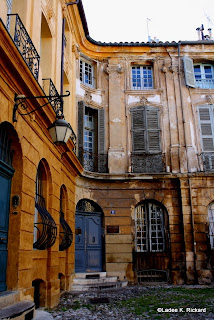
 One of the three enclosed sides has been fixed and painted. This is the "after" photo. This must be recently finished because the googlemaps view shows scaffolding in front of this building.
 To the right of the building is an unfinished section. What a difference!
 You can see the before and after, side by side.
 The cobblestone in the area is cute too.

At this point, we turned right on Rue Aude to continue the tour. (Continue to Part 2)
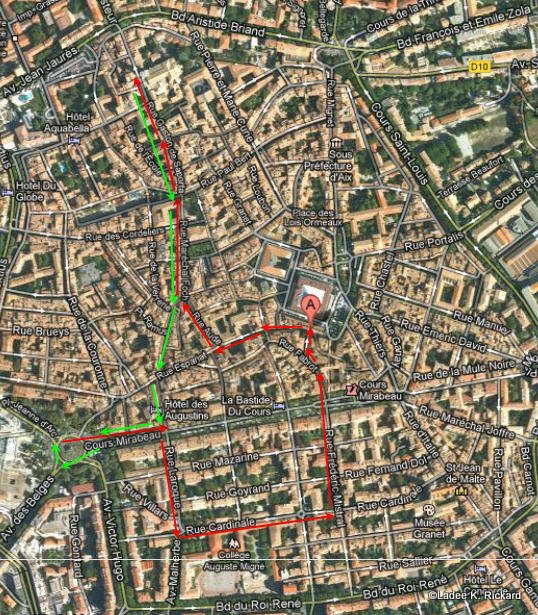
The first map
shows our detailed map and the second one shows our entire walking tour of the
city. The "medieval section" along the walking route from #3 to
#4 is covered in multiple posts. The order that you read the posts is not
important unless you are looking at the street locations.

We crossed Cours Mirabeau and walked past "Les Deux Garcons". I didn't know this at the time, but this was a legendary brasserie known informally as the 2Gs. Paul Cezanne used to come here and enjoy a three hour aperitif (from 4PM - 7PM!) with friend Emile Zola and others.Very many other famous names have downed a glass here too, including Picasso, Churchill, Mistangett, Edith Piaf, André Malraux, Jean-Paul Sartre, Raimu, Alain Delon, Jean-Paul Belmondo and Jean Cocteau. I will make it a point to stop here on my next visit!
We passed Fontaine de l'eau Chaude (Fountain of Hot Water). It is a strange looking fountain was built in 1731 and uses water from a hot spring. It is covered in moss. As people walked past it, they would lean over and touch the water.

We passed Fontaine de l'eau Chaude (Fountain of Hot Water). It is a strange looking fountain was built in 1731 and uses water from a hot spring. It is covered in moss. As people walked past it, they would lean over and touch the water.

Moving on, the old look of the city starts to show as soon as we enter the area. We started north on Rue Fabrot.


Street signs help to point you in the right direction through these winding streets.

We soon came to the Museum of Natural History. We didn't go in. It is in a "charming" mansion.


On one side of the courtyard are two windows with unique and interesting iron balcony railings. The tour guide indicated that business owners could not display signs for business that dealt with "pleasure", so indicated (through the design in the railing) what could be found inside.


At this point, we turned right on Rue Aude to continue the tour. (Continue to Part 2)
Aix-en-Provence - quartier Mazarin
This post covers the section of the tour between #2 and #3 on the map.


Aix-en-Provence, France - Cours Mirabeau
Aix (originally Aquae Sextiae) was founded in 123
BC. The tour guide, Juan, gave an
explanation how the name gradually changed from the name given by the Roman
consul Sextius Calvinus to the hot springs found in the area to today’s version
but I don’t recall the details. If I can
figure this out, I will post the answer in the comments.
Oh, in case you were wondering,
Juan explained that he is a native Frenchman whose mother is from northern
Europe and gave him a Spanish name. He
said that he had no further explanation than that. He lives in Marseille.

Marseille, France - Country side view Aix-en-Provence
We left our ship and hopped on the bus for a ride through the south of France. The countryside reminded me of Arizona as we rode north from Marseille to Aix en Provence. This is what I saw as I gazed out of the bus window.


Subscribe to:
Posts (Atom)
Why Are There So Many British People in the Dordogne?
Why Are There So Many British People in the Dordogne? What you have noticed around Château Marouatte is not incidental. The Dordogne has ...

-
 I just took the photos, many many photos, so that I would have them to look at when I returned home and could research this building. The P...
 -
 The Ox Bow Saloon is on the National Register of Historical Places so I thought that I would drive down "historic Main Street" and...
 -
 After check in, I decided to take a photo walk on my street Na Porici to become familiar with the area. This seems to be a good transportat...